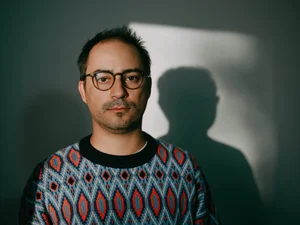

Article on “Musica.com.Pt” about “Of Fragility and Impermanence”
“André Carvalho’s new album arrives today, November 7, and deserves all attention. Of Fragility and Impermanence lands on digital platforms and in physical format (CD and vinyl) via Robalo Music, presenting twelve instrumental tracks that act as meditations on uncomfortable themes: aging, winning, losing, raising children knowing they will one day suffer and be far from home, and/or the constant awareness that nothing lasts.
The Portuguese composer and bassist returns to conceptual albums after Lost in Translation and The Garden of Earthly Delights, but this time the starting point is brutally personal. André Carvalho transforms all these ingredients into instrumental music where jazz, contemporary composition, and electronics coexist in the same space, with an extremely sincere and mature approach that feels like a film soundtrack.
How to construct an album about unspoken things
Of Fragility and Impermanence grabs hold of us. Even if we try to listen passively, we end up immersed in a journey that demands our full attention. There are no choruses to repeat ad infinitum, no comforting structures, nor is that the aim.
In this album, it is hard to tell where composition ends and improvisation begins, and perhaps it is these moments of discomfort—or comfort, tension or resolution—that convey such vivid imagery, a territory André Carvalho knows well and explores with intelligence and mastery.
The album opens with A Galope, an urgent track that throws us into the work without preamble or sugarcoating. The instruments unfold in arpeggios, counterpoints (I couldn’t help but hear hints of Steve Reich at times), dissonances, delays, and reverse delays, delivering a small moment of peace and consonance near the end before dissolving entirely.
Next comes Dente de Leite (first as an intro, then full version), which takes us through the entire (figurative, of course) process of the emergence and loss of the first set of teeth. We feel the first teeth sprouting, enjoy a brief moment to breathe where everything calms, before gradually experiencing the dissonant “destruction” of structures. The instruments, effects, and composition brilliantly paint this picture.
Dores de Crescimento, the fourth track and second single, remains one of the album’s strongest moments. José Soares’ saxophone and Samuel Gapp’s piano create beautifully delicate passages, amplified by João Hasselberg’s electronics without exaggeration. Growing pains, yes, but André Carvalho does not dramatize; instead, the track carries a sense of nostalgia and gentle melancholy, looking back with years of perspective.
The video teaser for this track perfectly illustrates this, showing André Carvalho as a child through archival footage, and as a father, sitting in his daughter’s room, recalling and evoking a distant past.
These fragments of memory lead into the track Echoes, where memories, instrumentation, and emotions dazzle and dominate, then recede into the background, leaving space for snippets of voices—some in Portuguese, others in English, some pitch-shifted—like a distant family dialogue across time.
The instruments grow as the track unfolds, introducing some dissonance without becoming overwhelming—perhaps like a fog that prevents us from recalling every detail as if it happened only five minutes ago.
Mèrancolie is a more ethereal track, offering a dense yet breathable atmosphere, where saxophone and delays gently assert themselves, possibly presenting melancholy as a natural state rather than a clinical pathology.
Infância revisits memories without succumbing to sugary nostalgia, evoking moments of running through a playground, effects reminiscent of video game milliseconds, but also pauses to catch our breath after so much activity. Melodic and harmonic moments contrast with brief dissonances—a territory André Carvalho often explores to introduce tension and release throughout his compositions.
The Journey of Kanji Watanabe, referencing the protagonist of Akira Kurosawa’s film Ikiru, guides us through multiple phases. It begins with emptiness dominated by piano and cello, moves through bittersweet searches for meaning where saxophone and bass emerge, and concludes in redemption and purpose as the character finally finds peace and resolution.
One of the album’s most urgent pieces is No man ever steps in the same river twice, for it’s not the same river and he’s not the same man. A long title conveying a simple idea: nothing repeats, everything transforms. André Carvalho materializes Heraclitus’ (and perhaps Lavoisier’s) philosophy in a constantly evolving composition, where melodies return but never sound the same, building to a crescendo. The production deliberately supports this concept, adding unexpected textures that echo the title’s implicit nature.
The Restlessness of the White, as its name suggests, is a restless track, minimal and subtle like the color white. Beginning in silence, the composition gradually takes shape discreetly. Instruments, samples, and effects enter and exit in turn, creating moments of unease that dissolve like clouds.
Study for a Bullfight #4, inspired by Picasso’s painting, presents a track where rigid forms dissolve, leading to a more fluid, expressive composition, free from strict structures or cadences. Another ethereal and minimal piece, tinged with sadness, unease, or discouragement through its expressive instrumentation.
Finally, Trica de Irmãos brings us home, offering comfort and fond memories through a vivid image—a minor squabble between siblings, a small argument that is nothing serious and even healthy, resolving earlier tensions, fostering maturity, and strengthening bonds for the long term.
Five musicians and a studio in Serpa
Of Fragility and Impermanence was created at the Centro Musibéria in Serpa, during an artistic residency supported by Antena 2 and the GDA Foundation. José Soares (saxophone), Samuel Gapp (piano), João Hasselberg (electronics), and Raquel Reis (cello) joined André Carvalho on double bass and compositions. The five musicians closed themselves in the studio, with time to explore ideas, improvise, and create without limits until achieving the result we hear today.
The choice of timbres reflects careful curation; nothing here sounds conventional or safe. André Carvalho and the ensemble pursue unconventional sounds, rough textures, and silences as weighty as played notes. The final production embraces these rough edges rather than hiding them—a bold choice in a market obsessed with perfection and the rigidity of a digital timeline.
André Carvalho: from conservatories to cinema
André Carvalho has an extensive résumé spanning continents and genres. He studied at the Manhattan School of Music and the University of Music and Performing Arts Vienna after abandoning a career in computer science—André was already programming at age seven. A few years later, the Fulbright Program took him to the United States in 2014, where he performed at New York’s Blue Note and collaborated with artists like Chris Cheek and Will Vinson.
Like a devoted son returning home, André Carvalho came back to Portugal, while continuing to work internationally and develop his art. Among his awards and performances, highlights include performing in Gilberto Gil’s opera Prelúdio at London’s Barbican Centre and Helsinki’s Finlandia Hall, as well as appearances at festivals and concerts in Paris, Cairo, Ljubljana, and other capitals. He won the Carlos Paredes Award (2012), Best Group at the Bucharest Jazz Competition (2011), and multiple grants from the GDA Foundation.
As previously mentioned, his discography includes highly recommended works such as The Garden of Earthly Delights (2019, inspired by Bosch) and Lost in Translation (two volumes, 2021 and 2023).
Cinema, however, remains a particularly fertile and inspiring territory for André Carvalho. His soundtrack for Atom & Void (directed by Gonçalo Almeida) earned him the Best Music award at the Short Shorts Film Festival (Japan) and a Sophia Awards 2025 nomination. In 2024, he won Best Original Music at the Planos Film Festival for Canto by Guilherme Daniel, and was a finalist at Oticons 2023 and the Berlin International Film Scoring Competition.”
Read article here.
Portuguese Version (Original
““Of Fragility and Impermanence” confirma André Carvalho como um artista singular no panorama musical português. Num disco que funciona tanto como banda sonora para momentos de contemplação quanto como obra autónoma de arte sonora, o compositor prova que é possível fazer música profundamente pessoal sem cair no hermetismo, universal sem perder a especificidade.”
“Para quem procura alternativas ao ruído constante do quotidiano, este novo trabalho oferece exactamente isso: um espaço de silêncio povoado por sons que importam, reflexões musicais sobre o que nos torna humanos. Carvalho conseguiu transformar fragilidade em força, impermanência em eternidade – pelo menos durante os 47 minutos que dura o disco.”
Read full article here.