

“[…] bassist André Carvalho, whom you should get to know” - Nate Chinen in Take 5 | WBGO
André Carvalho is a Portuguese composer and double bassist whose work explores the intersections between jazz, contemporary music and improvisation. His practice is driven by a strong interest in narrative and storytelling, and by the possibilities that emerge when music encounters other forms of artistic expression.
With six albums released under his own name, Carvalho has developed a body of work shaped by conceptual projects and a constant search for new expressive languages. His recent work includes "Of Fragility and Impermanence" (2025), centred on vulnerability, parenthood and the fleeting nature of human experience; the two-volume "Lost in Translation" (2021/2023), exploring untranslatable words and the emotional landscapes they inhabit; and "The Garden of Earthly Delights" (2019), inspired by the enigmatic visions of Hieronymus Bosch.
His work has been described by All About Jazz as "both in bounds and out of this world." He has performed internationally at venues and festivals including Blue Note New York, Konzerthaus Berlin, London’s Barbican Centre, Cairo Jazz Festival, Jazz Festival Ljubljana, Guimarães Jazz and Centro Cultural de Belém. He has collaborated with artists such as Chris Cheek, Will Vinson, Tommy Crane and Gilberto Gil, with whom he toured internationally in the opera "Prelúdio". His work has received several distinctions, including the Carlos Paredes Award and Best Group at the Bucharest International Jazz Competition.

Alongside his work as a composer and performer, Carvalho has developed an increasingly active practice in film and audiovisual music. After completing the post-graduate programme at the Film Scoring Academy of Europe as a grantee, he has collaborated with filmmakers including Gonçalo Almeida, Bruno Carnide and Guilherme Daniel, among others. His score for "Atom & Void" received the J-WAVE Sound of Cinema Award at the 2025 Short Shorts Film Festival & Asia in Japan and the Méliès d’Argent, and the film was screened at festivals including Fantastic Fest and Sitges. His score for "Canto" received the Best Original Music award at the Planos Film Festival. His work in film scoring has also been recognised through finalist positions in the Oticons Film Music Competition and the Berlin International Film Scoring Competition.
Originally trained in Computer Science, Carvalho later studied at the Hot Clube de Portugal and the Academia de Amadores de Música before moving to the United States as a Fulbright grantee. He holds degrees from the Manhattan School of Music and the University of Music and Performing Arts Vienna.
Photo by João Hasselberg
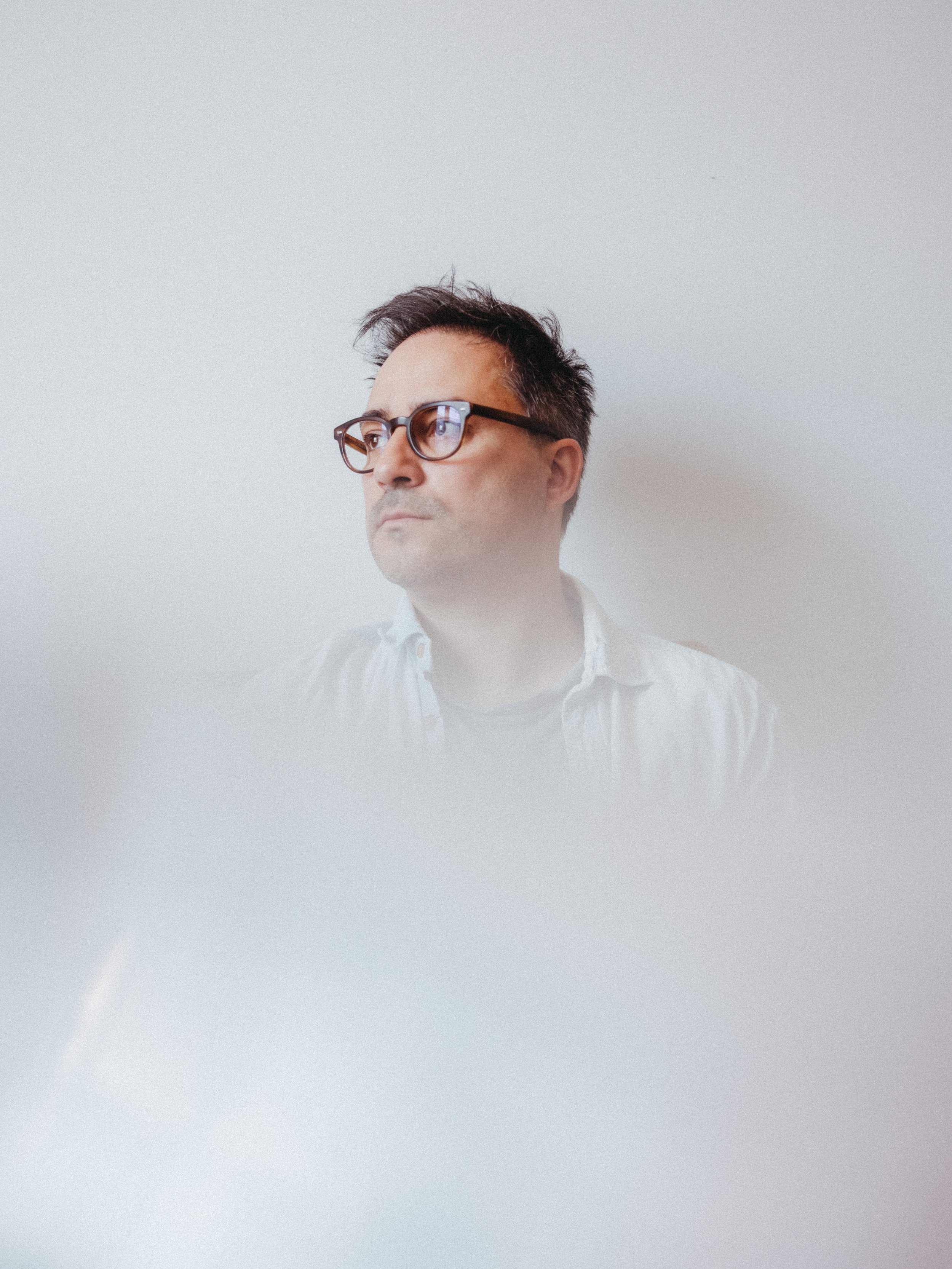
Photo by João Hasselberg
“I was destined to be a computer nerd. By the age of 5, I was playing video games created by my grandfather, and by 7, I was programming on my own. Breaking the rules and not settling was always part of it for me. After graduating with a degree in Computer Science at 21, I confronted my destiny and, for the first time, learned what a bass clef is.”
Artist Statement
My musical obsessions often circle around narrative and storytelling - pathways to expand the imagination and explore the many layers of human experience. I strive to create music that strikes for transcendence, while leaving room for ambiguity, imagination and a sense of visceral intensity.
My work is often shaped by encounters with other art forms. Literature, painting and cinema have become important points of departure, offering different ways of thinking about narrative, time, space and perception. Rather than illustrating these references, I am interested in translating their emotional, psychological and symbolic qualities into sound.
Of Fragility and Impermanence draws from reflections on the fleeting and delicate nature of existence, while Lost in Translation explores the mystery of untranslatable words and the emotional landscapes they inhabit. Earlier, The Garden of Earthly Delights found its voice in the enigmatic visions of Hieronymus Bosch. My work in film scoring has further deepened this dialogue between sound and image, allowing me to explore how music can shape atmosphere, tension, character and our perception of time.
Each project is part of an ongoing search: to discover how music can converse with other arts, and how these encounters can open new ways of experiencing sound, image, language and emotion. Rather than being defined by a particular genre or subject, I am interested in the possibilities that emerge when different forms of expression meet.
Ultimately, I see composition as a process of translation - between disciplines, between inner and outer worlds and between what can be articulated and what can only be felt.

Photo by João Hasselberg


